



By Dan Zarlenga, Missouri Department of Conservation
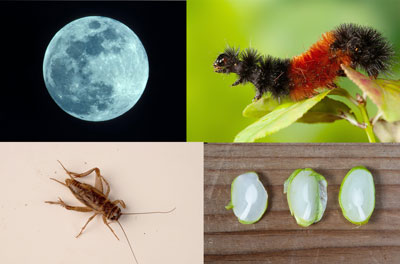
Photo caption: Which one of these would you trust to forecast the weather?
Photos courtesy the Missouri Department of Conservation.
October is often the last hurrah of beautiful weather before wintery conditions set in. For ages humans have tried to forecast the weather and predict what winter might bring. Today, we have the science of meteorology and modern tools like radar, barometers, and computer weather models to help us. But before all that, people were ferreting out clues in nature to forecast the weather.
Humans strive to make sense of a world that for most of history was beyond our understanding. It’s baked into our DNA. The instinct to want to see patterns in nature gives us the feeling that we understand it. Psychologists describe this phenomenon as patternicity.
Sometimes those patterns are real. Sometimes coincidence or wishful thinking fools us into seeing connections that aren’t there. Weather folklore is full of both.
One of the most popular tenets of weather folklore is the persimmon seeds. Persimmons are medium sized trees famous for producing round orange to purple fruits in September and October. Prevailing wisdom says that if you cut open the seed of a persimmon fruit the shapes inside forecasts the winter ahead. The figure of a knife is said to foretell cutting cold; seeing a “spoon” means you’ll be shoveling heavy snow; detect a “fork” and it predicts a light winter with only a dusting of snow.
That you’ll enjoy the sweet deliciousness of the persimmon fruit is likely a far more accurate prediction. Alas, there’s no science or real data to support this forecasting connection.
What about the old saying “Clear Moon, frost soon”? A visible, bright moon usually means clear skies. Without a blanket of clouds to act as insulation, the ground loses heat rapidly to the sky through radiational cooling. This can indeed set the stage for the formation of late night or early-morning frost, providing wind is low and the right amount of humidity is present in the air. So, this one does have a ring of accuracy.
Many an old-timer will tell you that the woolly bear can predict winter weather. Woolly bears are the caterpillar form of Isabella tiger moths. They have fuzzy bodies with dense, stiff hairs and are very commonly seen during autumn. Woolly bears are black on the ends of their bodies and rusty red to brownish in their middles. Legend says that the more black on the body, the harder winter will be.
In truth, science does tell us that the woolly bear’s color can echo conditions from the previous seasons, which cause changes in the caterpillar molts. But a real-world connection between their color and the winter to come doesn’t exist. Unfortunately, there’s no honorary meteorology degree for the woolly bear.
Another insect said to perform a weather-related wonder is the cricket. Popular thought tells us that if you count the cricket’s chirps, one can tell the outside temperature. Like all insects, crickets are ectothermic, which means they derive their heat and energy from the external environment. Warmer air causes the cricket’s metabolism to rise, giving it more energy to chirp faster. Simply count the number of chirps in 15 seconds and add 37. The answer should be very close to the actual temperature in degrees Fahrenheit.
Thankfully for us here in the U.S., the crickets haven’t switched to the metric system yet.
It turns out relying on folktale signs in nature to predict the weather is, well, a bit unpredictable. Sometimes nature is giving us a genuine clue — and sometimes we’re simply telling ourselves a good story.
There’s really no harm in listening to the crickets, examining those persimmon seeds and watching the October moon. But don’t put aside your trusty weather app just yet.